
When we were designing Casa Roca, we had one rule we kept returning to: the building should feel like it belongs in Bali, not like it was dropped onto a Bali street.
This sounds simple. It isn’t. The pressure in hospitality design — especially at the budget-to-mid-tier level — is toward fast construction, cheap materials, and whatever can be replicated quickly. Concrete block walls. Pressed-timber veneers. Floor tiles imported from Java. A coat of white paint. Done.
We went a different direction. Here’s why, and what it actually means for the way Casa Roca feels to stay in.
The Case for Limestone
The primary material in Casa Roca’s exterior walls is Paras Putih — a white limestone found in Bali’s Bukit peninsula. It’s been used in Balinese architecture for centuries, most visibly in temple and palace construction.
Paras limestone has a few properties that make it ideal for a tropical coastal building:
1. Thermal mass Limestone absorbs heat during the day and releases it slowly at night, moderating internal temperatures. A thick limestone wall keeps a room cooler during the hottest afternoon hours than a thin concrete block wall would.
2. Breathability Unlike sealed concrete, limestone is slightly porous — it allows small amounts of moisture and air exchange through the wall. In Bali’s humidity, this makes a real difference to how a room feels.
3. It ages beautifully Concrete walls in Bali stain, crack, and develop an almost immediate sense of neglect. Limestone, by contrast, develops a patina over time that makes it look more beautiful, not less.
Reclaimed Teak: Why It Matters
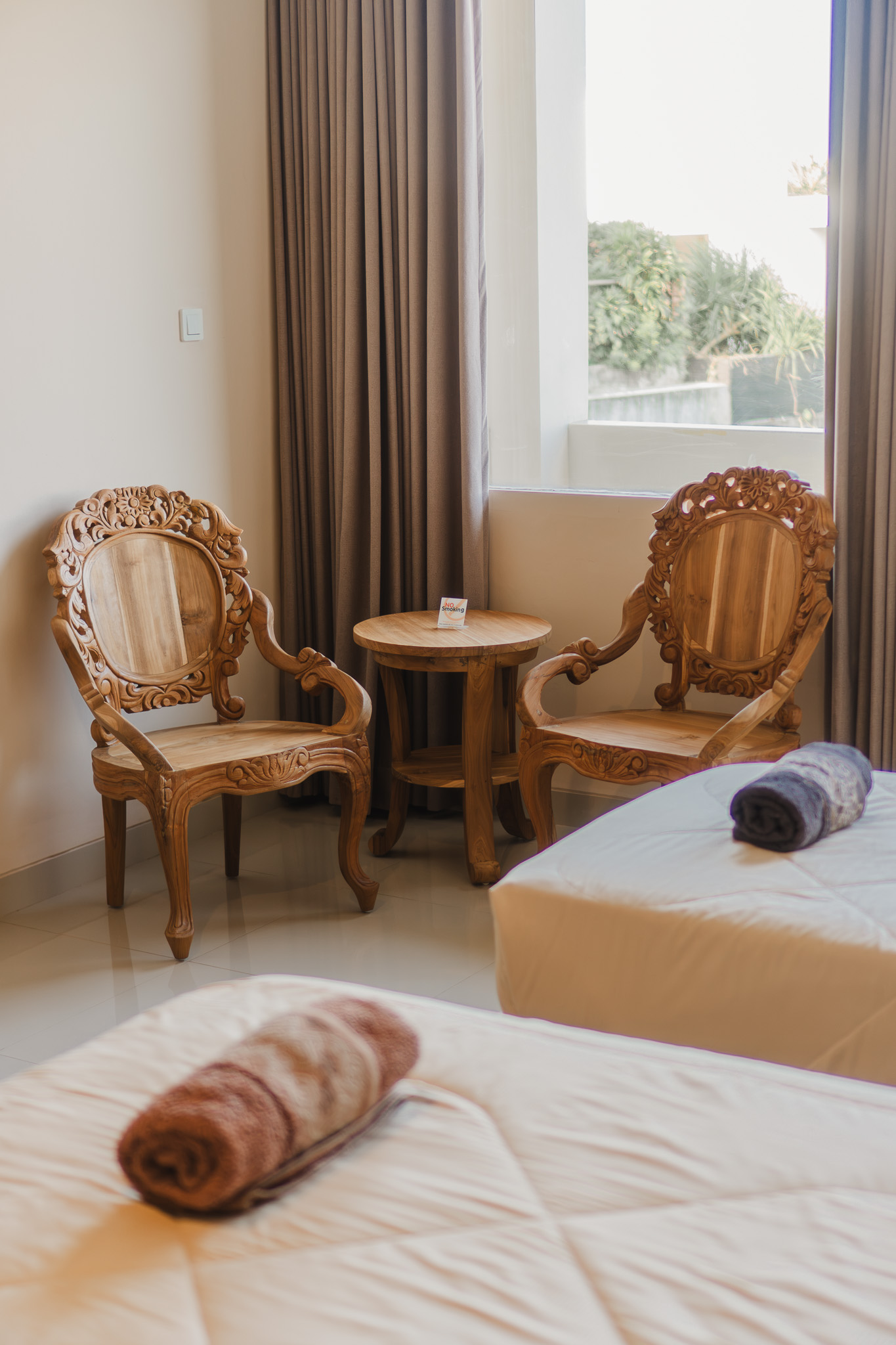
Every piece of solid wood furniture in Casa Roca — the beds, the desks, the wardrobe frames, the door panels — is made from reclaimed teak sourced from Javanese craftsmen who work with decommissioned boat timber and dismantled warehouse structures.
Why reclaimed rather than new plantation teak?
Reclaimed teak is old-growth wood — denser, harder, and more resistant to tropical humidity than young plantation teak. It also carries the grain character and color depth that new teak doesn’t have.
There’s also an environmental logic: reclaimed timber is not a new resource draw. The wood already exists. Using it is a decision to find beauty in what’s already there.
The texture of reclaimed teak is tactile in a way that engineered wood or MDF-with-veneer simply isn’t. When you put your hand on the headboard or run your fingers along a Casa Roca desk surface, you’re touching something that has a history.
The Acoustic Design Decision
One of the consistent surprises our guests mention: it’s quiet. Not just “pretty quiet” — genuinely quiet in a way that’s unusual for a property 200 meters from a busy beachfront street.
This is partly the limestone walls. But it’s also a deliberate setback design — the rooms are positioned around a central courtyard that acts as a buffer zone, pulling the primary sleeping spaces back from the street noise.
The private balconies are oriented toward the internal garden, not toward the road. When you open your sliding glass door in the morning, you hear birds and the distant sound of the ocean, not scooters.
On Air Conditioning
We chose individual inverter split systems for each room rather than a centralized system. This matters because:
- Each guest controls their own temperature independently
- Inverter compressors are significantly quieter during operation
- They’re more energy-efficient than older on/off compressor units
- Rooms can be cooled to their actual temperature faster
The architecture does some of the cooling work. The AC does the rest. The combination means the AC doesn’t have to work as hard, which means lower noise levels and lower energy consumption.
The Small Details
Architecture is also the details that no one photographs but everyone experiences:
The door hardware is brushed bronze rather than polished chrome — it develops a subtle warmth over time and doesn’t show fingerprints the way chrome does.
The bathroom tiles are handmade terracotta zellige tiles from a small workshop in Ubud. No two tiles are exactly the same shade. This inconsistency is the point — it gives the bathroom texture that factory tiles don’t have.
The balcony screens are carved from Javanese teak in a traditional motif. They provide shade and privacy while letting air circulate. They were designed by a craftsman in Jepara and took two months to produce.
None of these choices were cheap. All of them affect how the space feels to be in — and, we think, how guests feel when they wake up in the morning.
Casa Roca is open for direct bookings on Jl. Pantai Batu Bolong, Canggu. If you want to experience the space rather than just read about it, check availability here.